
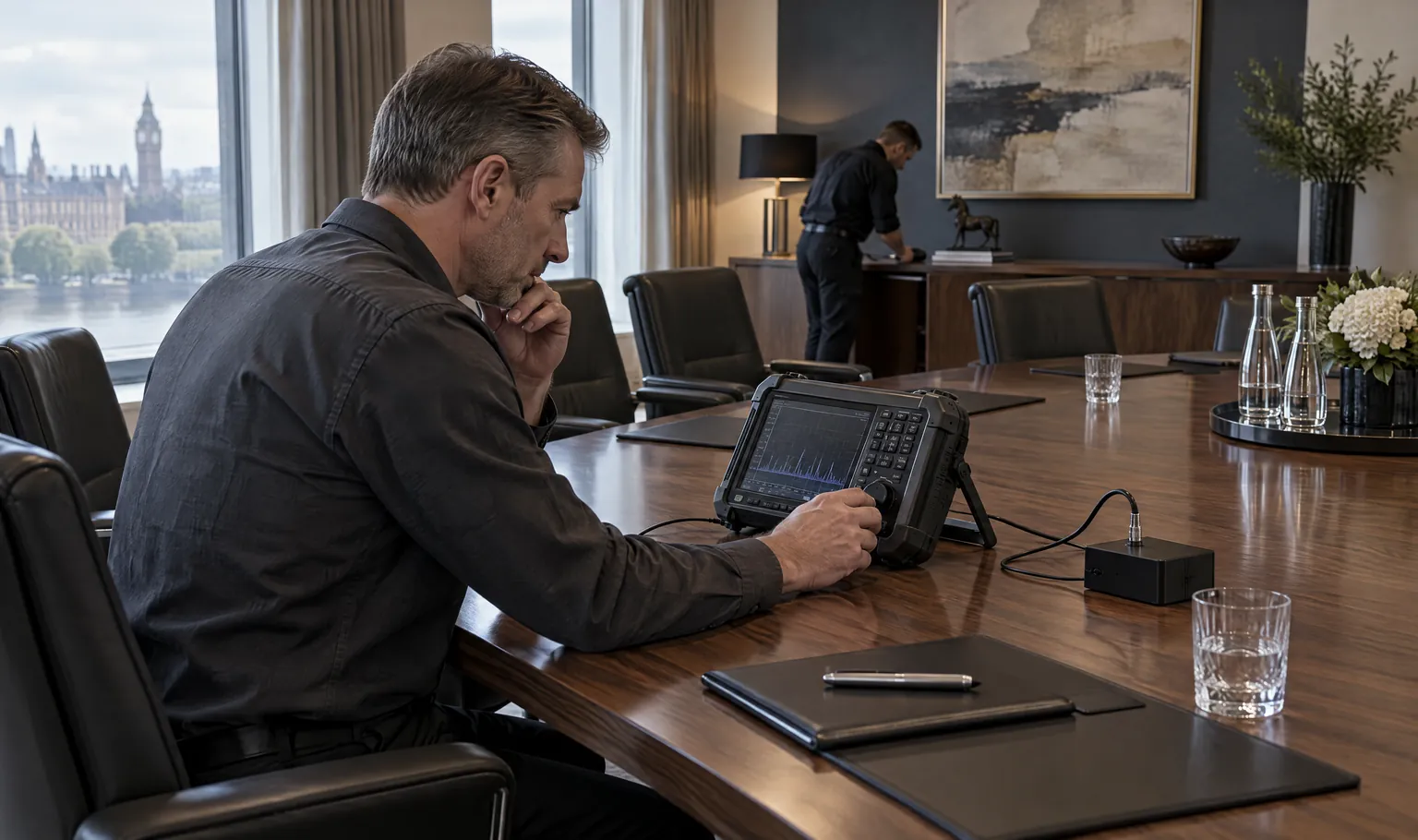
Technical surveillance countermeasures (TSCM), often called a bug sweep, is a specialist inspection for hidden listening devices, cameras, trackers and other surveillance technology. King Safety and Security (KSS) arranges and manages discreet TSCM surveys of homes, offices, vehicles, aircraft, yachts and temporary locations, in the UK and internationally.
When a survey is worth considering
Some clients come to us with a specific suspicion. Many more want reassurance at a moment when the risk has changed:
- Before sensitive board, legal or transaction meetings
- After contractors, maintenance or refurbishment have given people access to sensitive areas
- When moving into a new home, office or secure space
- After a change of staff, or when a property has been left empty
- During travel involving hotels, rented meeting rooms, vehicles or aircraft
- After an unexplained leak of information, suspicious activity or a change in the threat
- As periodic assurance, where a persistent risk justifies it
Where surveys take place
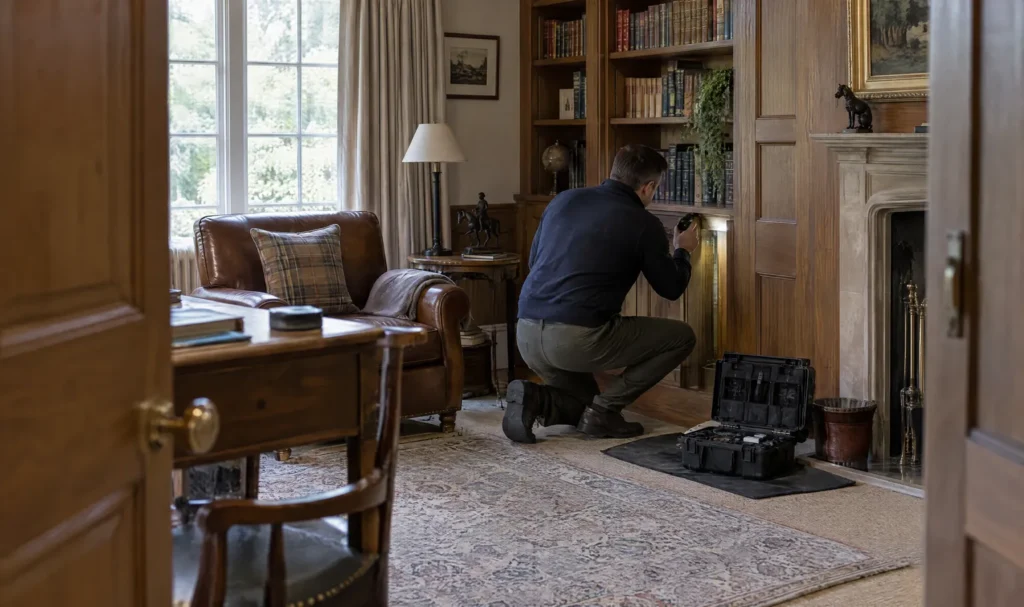
- Homes: private residences, estates, apartments, home offices and family spaces
- Offices: boardrooms, executive suites, meeting rooms and other sensitive business spaces
- Vehicles: executive, private and fleet vehicles
- Travel and temporary locations: hotels, rented meeting rooms and temporary offices
- Aircraft and yachts: private aircraft and marine vessels, subject to access and logistics
What a survey involves
No single instrument can account for every surveillance method. A proper survey combines several, and specialist technicians assess the results together:
- Radio frequency (RF) spectrum analysis: identifying and investigating signals of concern
- Non-linear junction detection: locating electronic components, including devices that are switched off or not transmitting
- Physical search: methodical inspection of fixtures, furniture, cavities, services and other places a device could be concealed
- Optical and thermal inspection: lens detection, close visual inspection and thermal imaging to support the search
- Borescope inspection: looking into spaces that are hard to reach, without unnecessary dismantling
- Line and infrastructure checks: telephone, data, power and installed systems, where the scope requires it
- Technical vulnerability review: weaknesses and unusual installations that may need further investigation
What a survey can and cannot tell you
A TSCM survey reduces uncertainty, and identifies technical and physical risk within the agreed scope. No inspection can guarantee that every possible surveillance method is absent, particularly in areas that cannot be accessed. Be cautious of any provider that guarantees to find every device.
How it works
- Confidential briefing. We establish the concern, the location, who has had access and what has changed recently.
- Scoping. A structured pre-assessment sets the areas to inspect, the priority rooms, the team and the equipment, based on the time available, the location and the threat. Where needed, this includes a site walkthrough.
- Quotation. We give you a price once the scope is clear, rather than before.
- Survey. Technical and physical inspection of the agreed spaces, at a time that suits the need for discretion.
- Debrief and report. A direct debrief on anything needing immediate attention, followed by written findings and practical recommendations where required.
- Record. Findings can be kept as a baseline for the property or asset. Later surveys can then be compared against it, to show what is new, changed or unexplained.
How KSS manages the work
TSCM is highly specialist work. We deliver it with a specialist technical partner, and KSS manages the engagement and remains your point of contact.
- Named technicians. Technicians are approved by name for each job, with qualifications verified with the issuing body and vetting to BS 7858. Nobody is substituted without our consent
- An agreed protocol if something is found. Chain of custody, police liaison and how you are told are all agreed in advance
- Your authority first. Device forensics or testing takes place only with your written authorisation
- Confidentiality. Principals can be identified by role or reference, sensitive details can be given verbally, and client details are never used in sales or marketing
- Quality assurance. KSS has quality assurance rights over the work and receives a formal handover after each survey
- One arrangement. We coordinate the survey with the household, security team or transport, so that it does not disrupt them or alert the wrong people
Discreet by design
We agree who needs to know that a survey is taking place, and keep the circle as small as the work allows. Surveys can take place in the evening, overnight or at the weekend. Where possible, the same technicians return to the same property, because someone who knows what is normal in a space is better placed to notice what is not.
If you think you have found something
- Do not handle, disconnect or move it
- Do not discuss it in the room, or near the device
- Make a note of what you saw, where and when
- Contact us from a different location, using a different device
We will advise you on what to do next, and how to preserve any evidence.
Awareness training for security teams
Protective teams do not need to become technicians, but they should understand the risk. We can provide practical TSCM awareness training for close protection, residential and corporate security teams, as a half-day or full-day session. It covers threats and concealment, how to search a room methodically, what the equipment can and cannot do, sensible pre-arrival checks, and what to do on discovery. It is an awareness course, and does not qualify anyone as a TSCM technician.
Part of a wider arrangement
- Residential Security Risk Assessment: the physical, personal and technical security of a home
- Family Office Security: periodic surveys as a managed part of the family’s security
- Surveillance and Investigations: where the question is who is responsible, or whether someone is watching
- Digital Risk: what is exposed online, as opposed to in the room
- Secure Transportation: vetted drivers and vehicle arrangements when a client travels
FAQs
It is a specialist inspection of a space, vehicle or aircraft for hidden surveillance technology, such as listening devices, cameras and trackers. It combines technical detection with a methodical physical search.
No. A survey reduces uncertainty within an agreed scope, but no inspection can rule out every possible method, particularly in areas that cannot be accessed. Be cautious of anyone who says otherwise.
TSCM is not a licensed activity in the UK, so anyone can buy equipment and offer a sweep. Ask who will carry out the work and what qualifications they hold, what methods they will use, whether you can see a redacted sample report, and what happens if something is found.
Leave it where it is, and do not discuss it nearby. Note what you saw, and contact us from a different location using a different device. We will advise you on next steps and how to preserve any evidence.
Usually, yes. We agree who needs to know at the outset, and the work can take place out of hours.
There is no fixed rule. Some clients use periodic surveys, while others arrange them before sensitive meetings or after significant changes, such as building work or staff changes. We will advise what the risk justifies.
Not as standard. A TSCM survey concerns physical spaces and technical surveillance. KSS is not a cybersecurity provider. Where network, wireless or cyber testing is needed, specialist partners can carry it out under a separate scope and written authorisation.
TSCM looks for technology. Counter-surveillance looks for people watching a person, property or route. Surveillance and Investigations covers the second.
Yes. KSS operates internationally. Moving specialist equipment across borders takes planning, so overseas surveys are best arranged with as much notice as possible.
Cost depends on the size of the property, the number of priority rooms and vehicles, the location and the urgency. It is not possible to quote accurately without those details, so we will give you a price once the scope is clear.
Speak to us away from the space in question.
Tell us what has prompted your concern. We will treat the conversation in confidence and tell you what a survey would involve.
We handle your details in confidence and in line with our privacy policy. We will only use them to respond to your enquiry.