
By Matthew Beer, Founder and CEO, King Safety and Security (KSS). Updated November 2026.
Every KSS close protection and residential security operative has passed the same full-day assessment: KSS’s proprietary Selection Day process. More than 400 protection professionals have been through it in the past five years, and most did not meet the standard. This guide explains why we run it, what it tests, what the assessors look for and how to give yourself the best chance.
For the full methodology, and how clients see it, see The KSS Selection Day.
Why we assess rather than interview
The traditional route into close protection work is agency-style: a CV, an interview, a couple of references and whoever happens to be available. I recruited that way earlier in my career, on a mixture of gut feeling, availability and client demand, and I learned the hard way that it does not work.
The role is too important for that. Accepting a candidate’s assurances in an interview, without testing them before they stand beside a paying client’s Principal, is a disservice to everyone: the client, the team and the operative. Training standards across the industry are inconsistent, and a licence is a floor, not a measure of quality.
Messaging groups and word of mouth are useful ways to let people know a selection day is happening. They are not quality control. That responsibility sits with the company that puts the operative in front of the client.
What raises standards is simple to say and harder to do: a process, data, and a clear pass or fail.
What the day tests
KSS does not publish the full content of the day, so that every candidate is assessed fairly. The areas covered include:
- group discussion, including difficult topics
- observation and memory
- introductions and briefings
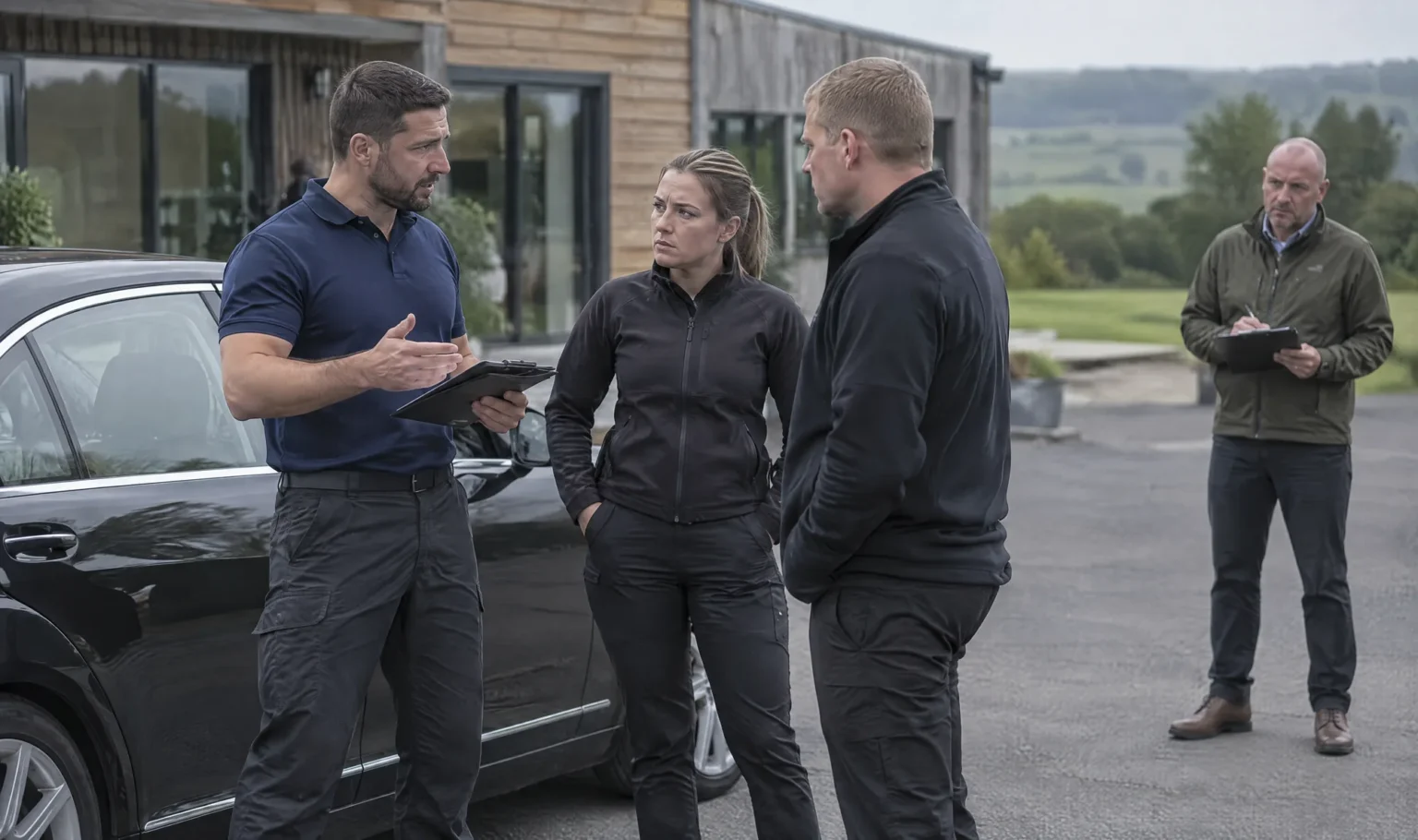
- security advance party (SAP) and close protection scenarios
- practical drills
- reconnaissance and research
- map reading and navigation
- first aid knowledge and scenarios, to FREC 3 standard
- current affairs and general knowledge
- a final interview
Scenarios can change without warning, so a candidate part-way through one task has to switch to another under pressure. Real protective failure tends to happen in those transitions.
What the assessors look for
We want to see sound knowledge of close protection, but we place as much weight on attitude and approach. Assessors look at:
- how candidates present themselves and treat other people, from first contact to the end of the day
- whether they can lead, and whether they can contribute as part of a team
- how they deal with pressure and conflict
- judgement, composure and the ability to own a mistake
Every candidate is scored against a defined matrix, and assessors rotate between groups so that no result rests on one person’s impression. A pass mark exists, but conduct on the day can fail a candidate regardless of points. There is no place for ego in this work.
Why most candidates fail
In the Selection Day data KSS published in July 2024, an average of 32% of candidates passed the assessment stages before fitness testing. That is not because the day is impossibly hard. It is designed to identify people who are not ready for this work, and most who fail do so for the same reasons: lack of preparation, ego, or not grasping the fundamentals of protection.
If you are well presented, articulate, free of ego and able to perform the core competencies of close protection, there is a good chance you will pass.
How to prepare
You are unlikely to transform your skills between booking and attending, but you can give yourself the best chance:
- Treat your first email as part of the assessment. Send your CV with a covering note that says who you are, why KSS and what you would bring. It is read.
- If you cannot attend, tell us. Candidates who do not turn up without notice are not invited again.
- Read the joining instructions and follow them.
- Dress smartly and appropriately, with good grooming.
- Refresh your first aid and close protection knowledge, and practise map reading.
- Read the news in the days beforehand.
- Be courteous to everyone, other candidates included. You are being observed throughout.
- Do not smoke or vape during the day.
- Remember it is an assessment, not a course. Commit fully and show what you can do from start to finish.
After the day
Passing is a beginning, not a verdict. Every successful candidate receives a debrief from KSS’s Operations Manager covering their results and the areas to develop, with structure attached: mentorship through KSS’s Project Insight programme, formal training, or signposting to the right external providers. Candidates then complete vetting to and beyond BS 7858, including open-source digital screening, before structured onboarding.
What happens next depends on experience and on the work available:
- some graduates are onboarded quickly into an existing team
- some join KSS’s approved list and are offered work that fits their experience as it arises
- less experienced graduates usually start in a larger team, mentored by an experienced team leader
- experienced graduates may move into team leader or consultancy roles
Unsuccessful candidates get something useful too: the scoring shows clearly where they are strong and where they need to develop.
Why it matters
Clients can be confident in the person standing beside their Principal. Operatives know that everyone else on the team has passed the same standard, and can rely on each other. And over time, a process that only puts proven people in front of clients pushes the whole industry towards a higher standard.
How to apply
KSS does not recruit speculatively. Selection days run when operational requirements exist, and attendance is by invitation after pre-screening. There is no fee to attend.
To register your interest, email hr@ksands.co.uk with your CV and a covering note.
Further reading
- An insight into the close protection operative selection process, by David Breen MVO MSc
- Close protection operatives: stop posting yourself online
- Strategies to help avoid burnout in close protection
Frequently asked questions
Is a selection day a training course?
No. It is an assessment, and there is no fee to attend. Candidates who pass may be given development afterwards, including mentorship and training, but the day itself exists to select.
How hard is a close protection selection day?
It is not designed to be impossible. In KSS’s published 2024 data, an average of 32% passed the assessment stages before fitness testing, mainly because many candidates arrive under-prepared or let ego get in the way.
What does the day include?
Areas include scenarios, observation, briefings, reconnaissance, navigation, first aid, current affairs, group discussion and a final interview. KSS does not publish the full content.
What happens after I pass?
A debrief and development plan, vetting to and beyond BS 7858 including open-source digital screening, then onboarding. Depending on experience, graduates join a team, an approved list or a team leader role.
How do I apply?
Email hr@ksands.co.uk with your CV and a covering note. Selection days are held when operational requirements exist, and suitable candidates are invited.
Matthew Beer founded KSS in 2014 and has worked in protective security for more than twenty years, across UHNW households, family offices and corporate Principals in the UK, Canada and internationally.