
By Matthew Beer, Founder and CEO, King Safety and Security (KSS). Updated November 2026.
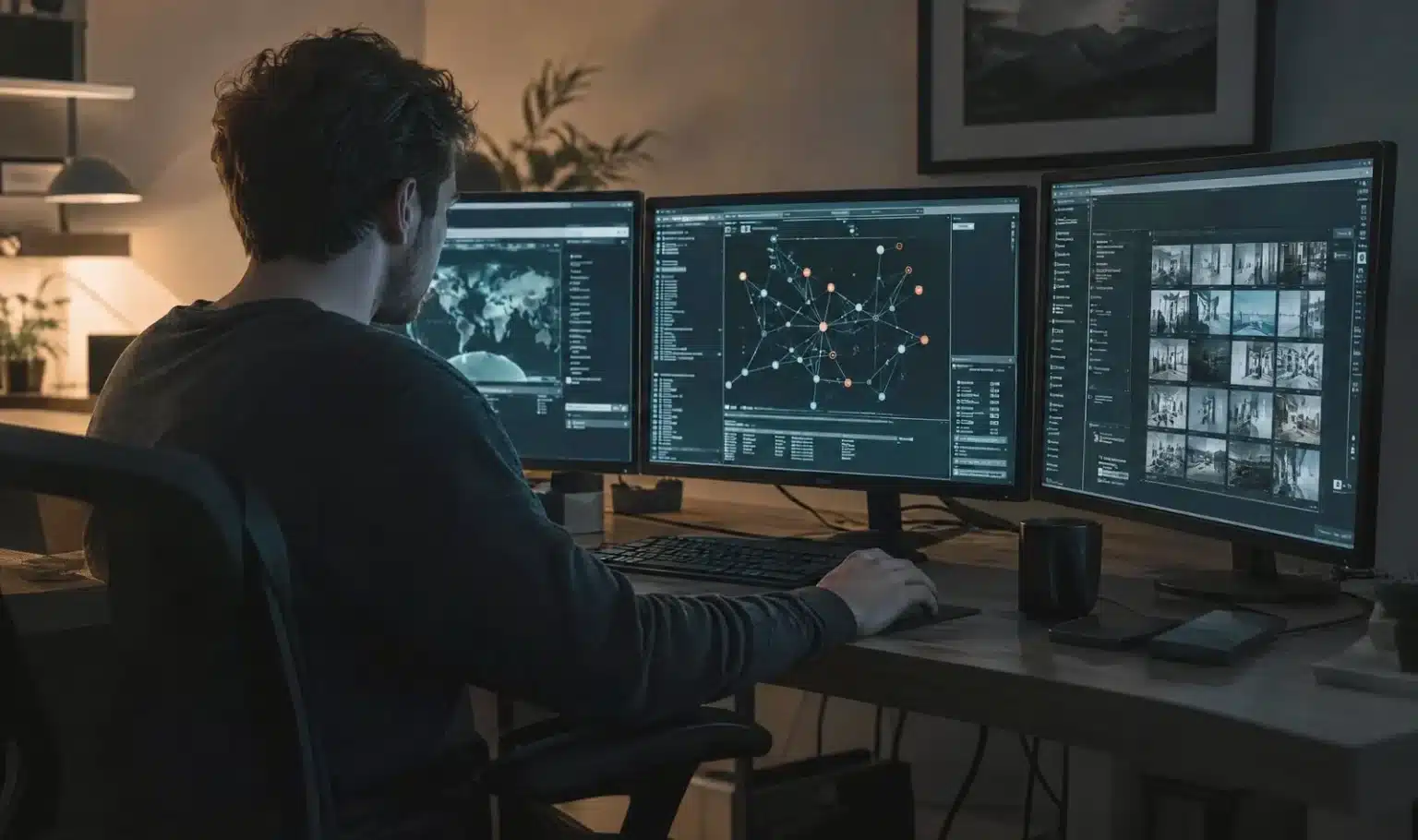
Long before anyone reaches a Principal, that Principal can often be studied in detail, without breaching a system or going near a gate.
The raw material is open source, which lowers the barrier for everyone. But a capable adversary does not simply browse. They aggregate, cross-reference and enrich what is public with brokered data and tooling, building a picture no single search would ever return.
Reconnaissance now starts online
Most protective operations are still built around the perimeter a Principal can see: the residence, the journey, the venue, the approach. Those things matter, but the work that precedes a credible threat is increasingly not physical. It is reconnaissance, and reconnaissance has never been cheaper to begin or more powerful in trained hands.
Artificial intelligence has made that aggregation faster still. We look at what it changes, on both sides, in What AI Can and Cannot Do in Close Protection.
What gets pieced together
Often the material is supplied by the Principal and those around them, voluntarily and indirectly. Typical sources include:
- property records, planning applications and company filings that connect a name to an address
- press coverage, event photographs and guest lists
- travel patterns, including aircraft and yacht movements that can be linked to an owner
- school, club and charity connections that reveal routines
- staff profiles that name an employer, a role and a location
- geotagged posts by family members, assistants, friends and well-meaning guests
- data broker and people-search sites that compile all of the above
Individually it looks harmless.
From data points to a pattern of life
Assembled by someone who knows how, it becomes a pattern of life: a map of routine and the moments at which a Principal is most reachable.
No single data point is the breach. The aggregate is. A family member’s public profile, an assistant’s predictable calendar, a residence that was never meant to be found, a tail number tied to a travel pattern. Each is defensible in isolation. Together, in the right hands, they are a targeting package.
The gap no one owns
This is digital exposure, one of the most consequential yet least owned parts of the modern threat picture. Physical security owns the gate; IT owns the network. The Principal’s real attack surface sits in the space between them, and in most structures no single person is accountable for it.
It grows continuously, is created largely by trusted insiders rather than hostile actors, and is often visible to an adversary before the people responsible for protection ever see it.
Protective intelligence is not cyber security
Network security does nothing for a Principal whose residence, movements and family routines can be reconstructed from open sources. Both matter, and they are different disciplines. An operation cannot run on two teams each quietly assuming the other holds the ground between them. It is a common arrangement, and an indefensible one the first time it is tested.
What protective intelligence work involves
This is where protective security has to evolve. In practice, the work falls into five parts:
- Map the exposure. Establish what can be learned about the Principal, the family, the homes and the staff, and how it connects. A Personal Vulnerability Assessment is usually the starting point.
- Reduce what can be reduced. Some information can be removed, corrected or made harder to find; some cannot, and has to be planned around. See Digital Risk.
- Watch for change. New coverage, a new post, a new address in the public domain or unusual interest in the family. See Intelligence Monitoring and Alerts.
- Brief the people who create it. Family members, assistants and household staff produce much of the exposure without meaning to. Practical guidance changes behaviour more than policy does. See Situational Awareness Training.
- Feed it into protective planning. What is known online should shape routes, timings, the residence and the visibility of any protection, rather than sitting in a separate report.
One owner for the whole picture
Whether a Principal has close protection, residential security or cyber support is no longer the question; those are components. The question is whether one person owns the Principal’s total exposure as a single managed picture, across the physical and the digital. That is how KSS runs Family Office Security and Corporate and Executive Security.
So the work has to begin earlier than the gate, earlier than the residence. It begins wherever the Principal can be found, and that has evolved. The perimeter is digital long before anyone reaches the gate.
Frequently asked questions
What is digital protective intelligence?
It is the work of understanding what can be learned about a Principal, their family and staff from open sources, how that information could be used to target them, and how protective arrangements should respond.
How is it different from cyber security?
Cyber security protects systems, networks and data. Protective intelligence looks at the person: what is publicly knowable about their homes, movements and routines, whoever holds the information. Most families and companies need both, and someone has to own the space between them.
Can information about us be removed from the internet?
Some can. Listings on data broker sites can often be removed, privacy settings can be tightened and some content can be corrected. Some public records cannot be removed, which is why the work also plans around what will stay visible.
Who creates most digital exposure?
Usually the people closest to the Principal: family members, friends, assistants and household staff, posting or sharing without any intention of causing harm.
How often should digital exposure be reviewed?
At least annually, and after any significant change, such as a move, a transaction, a new member of staff or a rise in public profile.
Matthew Beer founded KSS in 2014 and has worked in protective security for more than twenty years, across UHNW households, family offices and corporate Principals in the UK, Canada and internationally.