Communications in executive protection: Why your team is likely already behind…
Secure, resilient communications are rarely the headline risk in executive protection — but they are consistently the point of failure. This article outlines how professional close protection teams structure communications as a layered system, not a collection of devices.
There’s a question worth asking every time you brief a protection team before deployment: if the cellular network goes down in the next ten minutes, what happens?
For most teams, the honest answer is that coordination degrades, decision cycles slow, and the principal is left in a gap. Not because the operators aren’t capable — but because the communications architecture underneath them was never designed to survive infrastructure failure.
The silo problem in close protection communications
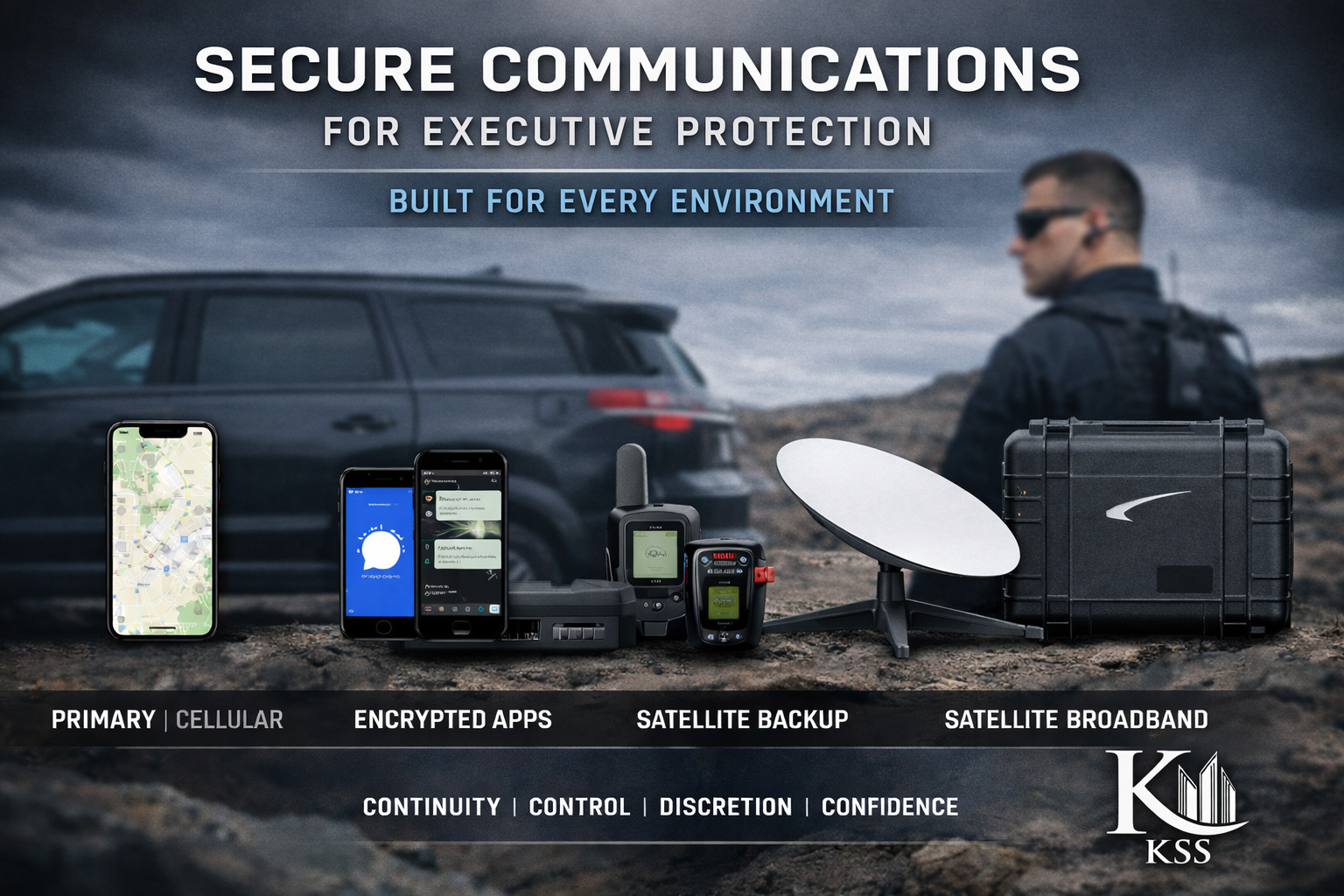
Executive protection has historically approached communications the way most sectors approach IT: piecemeal. Radios for team coordination. Mobile phones for client-facing interaction. A satellite device somewhere in the bag for genuine emergencies. Three separate systems, none of them integrated, each with its own failure mode.
Modern threat environments — blended physical and digital exposure, cross-border operations, high-density events where cellular infrastructure becomes saturated — demand something more deliberate. The best protective teams aren’t carrying more devices. They’re deploying layered communications architectures.
A four-layer model for executive protection communications
The most resilient approach structures secure communications across four distinct layers, each serving a specific operational function.
Layer 1 — primary cellular
The smartphone remains the foundation of close protection communications: lowest friction, highest familiarity, full data capability. For most operations, it’s the only layer that ever gets used. The problem is that it’s entirely dependent on infrastructure — and infrastructure fails.
Layer 2 — encrypted application layer
End-to-end encrypted platforms such as Signal are now the professional baseline for executive protection teams. They enable discreet operational coordination, separation of client-facing and team channels, and reduced exposure on open networks. Effective — but still connectivity-dependent.
Layer 3 — satellite redundancy
This is where genuine resilience enters the stack. Devices such as the Garmin inReach and Iridium GO! provide two-way messaging and voice capability entirely independent of terrestrial infrastructure. The Iridium GO! connects up to five devices via Wi-Fi within a 100-foot radius — usable across a small team without additional hardware. Worth stating clearly: maximum data bandwidth is 2.4 kbps. It handles messaging, essential voice, and basic situational updates. As a redundancy layer for close protection communications, that’s exactly what it needs to do.
Layer 4 — deployable satellite broadband
This is where executive protection communications architecture fundamentally changes character. The Starlink Mini — roughly laptop-sized and weighing 1.16 kg — delivers download speeds exceeding 100 Mbps and can be deployed from virtually any location with line-of-sight to sky. It operates at speeds under 100mph, which matters for mobile deployments. Power draw averages 20–30 watts post-connection, compatible with portable battery systems for extended off-grid use.
This transforms the operational question from “can we send a message?” to “we have full communications capability, anywhere” — VoIP, encrypted apps, VPN-routed traffic, multi-device connectivity over satellite broadband.
The underused layer: push-to-talk in close protection
Encrypted messaging and satellite connectivity attract most attention. Push-to-talk remains chronically underutilised despite being one of the most operationally efficient close protection communication modes available. Platforms such as ESChat provide structured talk groups, instant team-wide broadcast, and low cognitive load under pressure. When routed over Starlink rather than cellular, they become infrastructure-independent. The ability to transmit a situation update to the entire team simultaneously with a single press has direct operational value in high-tempo environments.
Three tiers of executive protection communications package
The architecture should be proportionate to risk profile, not budget ceiling.
Baseline — smartphone with encrypted messaging configured, plus satellite messaging backup (Garmin inReach or equivalent). Covers the majority of corporate EP assignments where cellular coverage is reliable and the primary threat is opportunistic.
Enhanced — the above, plus a deployable satellite hotspot and structured PTT for team coordination. Appropriate for international travel, multi-venue operations, and assignments where infrastructure reliability cannot be assumed.
High-risk and remote — the full stack, anchoring on Starlink Mini as the primary data layer, with VPN-routed traffic, multi-device connectivity, and full redundancy across all channels. Relevant for hostile environment operations, remote residential security, and principal movements through communications-degraded environments.
What clients are actually buying
Clients commissioning executive protection with structured communications aren’t purchasing technology. They’re investing in four outcomes: continuity (communication remains intact regardless of what the environment does to the infrastructure), control (decision-making doesn’t degrade at the moment it matters most), discretion (systems that operate without drawing attention to the principal), and confidence (documented assurance that failure points have been identified and mitigated before deployment).
The providers who communicate this clearly — and who can demonstrate a proportionate, layered architecture rather than a kit list — will operate at a different commercial level.
Why communications failures in EP go undiagnosed
When protective operations fail, post-incident analysis typically focuses on personnel, vehicles, and positioning decisions. Communications failures are more common, less visible, and rarely the subject of structured review. Breakdowns in coordination — a team that couldn’t reach advance, an operation that couldn’t escalate — tend to get absorbed into vague language about decision-making rather than diagnosed at the infrastructure level where the failure actually occurred.
Building communications as a system — layered, redundant, proportionate to risk — is one of the clearest differentiators between firms operating at a professional standard and those that aren’t.
Frequently Asked Questions
What communications systems do executive protection teams use?
Professional EP teams structure communications across four layers: primary cellular (smartphones), encrypted application platforms such as Signal, satellite redundancy devices such as the Garmin inReach or Iridium GO!, and deployable satellite broadband such as Starlink Mini. Each layer serves a distinct function and compensates for the failure modes of the layer below it.
Why do close protection teams need satellite communications?
Cellular infrastructure fails in high-density events, remote locations, and politically or technically degraded environments. Satellite communications — specifically two-way messaging devices operating on the Iridium network — provide continuity of communication independent of terrestrial infrastructure. For high-risk and remote deployments, deployable satellite broadband such as Starlink Mini provides full operational capability anywhere.
Is Signal sufficient for executive protection communications?
Signal and equivalent encrypted platforms are now the professional baseline for EP team coordination — but they remain dependent on internet connectivity. They function as the security layer within a broader communications architecture, not as a standalone solution. In infrastructure-degraded environments, satellite redundancy is required to maintain continuity.
What is the Iridium GO! used for in executive protection?
The Iridium GO! connects up to five devices via Wi-Fi and provides two-way messaging and voice over the Iridium satellite network at 2.4 kbps. In executive protection, it functions as the continuity layer — maintaining basic communications when cellular infrastructure is unavailable. It is not a broadband device and should not be positioned as one.
What does Starlink Mini offer for close protection operations?
Starlink Mini is a laptop-sized, 1.16 kg satellite broadband terminal capable of 100+ Mbps download speeds, operable while moving at under 100mph, with a power draw of 20–30 watts. For executive protection, it enables mobile command capability, full encrypted application stack over satellite, and multi-device team connectivity in remote or hostile environments.